Actively maintained · core developer
oxDNA
The coarse-grained engine that lets DNA nanotechnology move at simulation speed
The problem
Every DNA origami design starts as a bet: will thousands of short strands actually fold into the shape a researcher drew? Atomistic simulation could answer that, but at the scale of a real origami structure — thousands of nucleotides, microseconds of dynamics — it's computationally out of reach for routine design work.
oxDNA solves this by representing each nucleotide as a single rigid body instead of dozens of atoms, with an interaction potential tuned to reproduce real DNA/RNA thermodynamics and mechanics. That trade-off is what makes it possible to simulate an entire origami's self-assembly, not just a fragment of one.
What I built
As a core developer, my work has focused on making oxDNA fast and correct at scales the original codebase wasn't built for: implementing non-singular mass support, bringing the CUDA backend up to modern GPU architectures, and optimizing the build for ARM (both aarch64 servers and Apple Silicon).
On the modeling side, I built a custom CUDA-optimized path that scales simulations up to roughly 6 million particles, and developed a new coarse-grained force field for irregular origami shapes using rigid-body physics and patchy particles — about 1000× faster than the standard oxDNA2 model for that class of structure. I also extended the patchy-particle force field used for DNA-mediated crystal growth, which fed directly into an experimental result: simulation-guided design that raised the crystal growth temperature by 12°C with a higher yield.
Where it shows up
oxDNA sits underneath most of the other tools on this page — oxView visualizes its output, oxCloud runs it in the browser, and nanobase stores structures designed for it. It's also the simulation backbone cited directly in the DNA-PAINT cryptography work published in Nature Communications, where oxDNA simulations were used to characterize the flexibility of the origami structures being imaged.
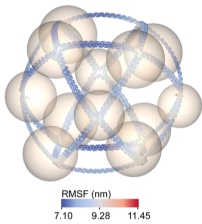
A spherical DNA origami simulated in oxDNA, colored by per-nucleotide RMSF (7.10–11.45 nm) — this kind of flexibility map is what let us characterize the origami structures behind the DNA-PAINT cryptography work.
Related publications
OxView, oxCloud and nanobase: an interactive interface for simulation, analysis and sharing of DNA and RNA nanostructures.
Roy, S., Sikand, N., Sample, M., Evans, J., Haggenmueller, S., Kikla, A., Matthies, M., Šulc, P.